

Álvaro
Data Scientist
“In a climate this uncertain, Shakers gives you a layer of reassurance and confidence. What I like most, without a doubt, is the flexibility and getting to work on top-tier projects.”
Join Shakers
Resources
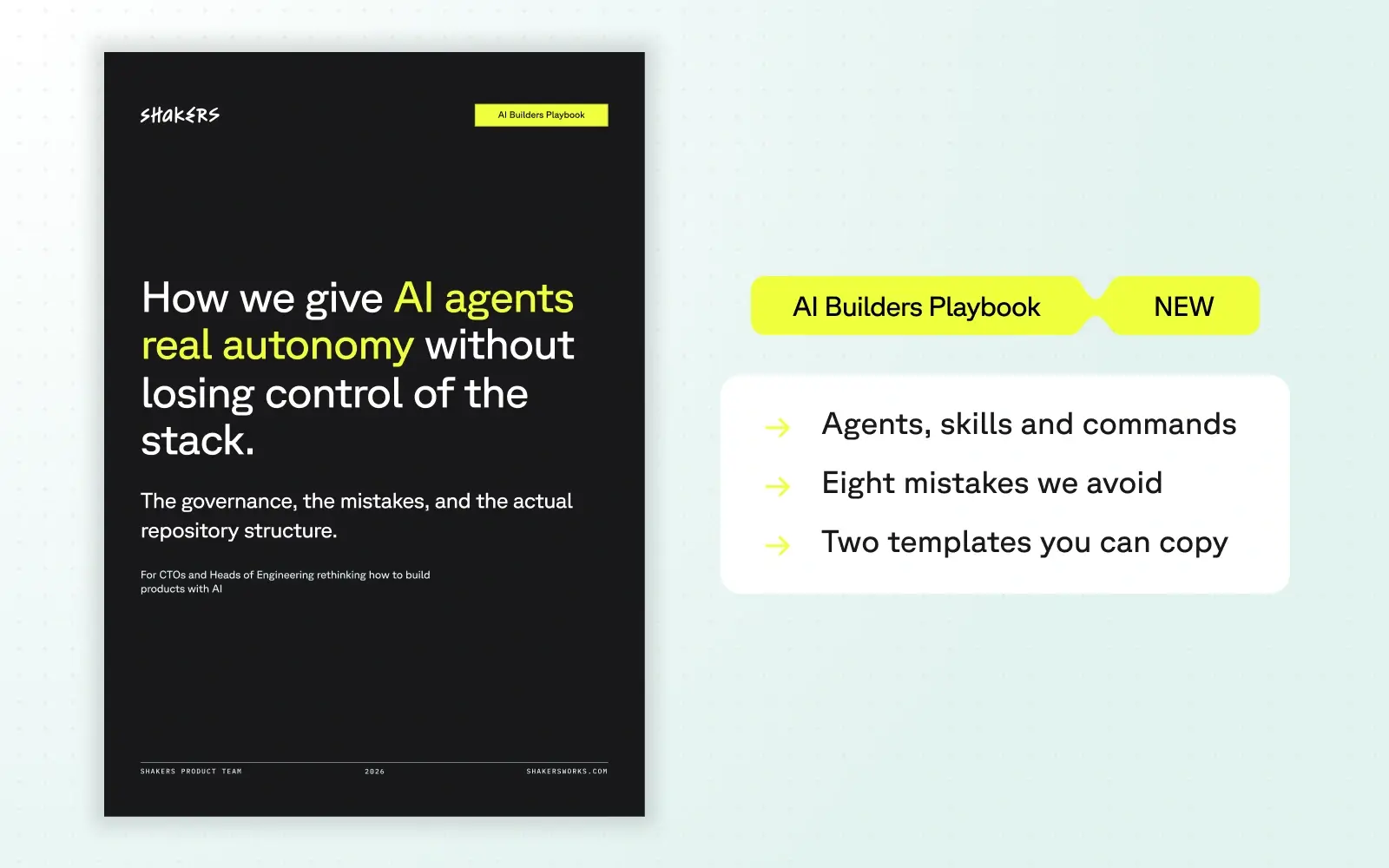
AI Builders Playbook
For CTOs and Heads of Engineering rethinking how to build products with AI.
Shakers for expert talent
Projects where the platform is yours: what enters the lakehouse, how Spark transforms it and who sees each table in the catalog. Shakers matches you with briefs aligned to your stack, rate and availability.
The role reads in two places: the posting asking for «Delta Lake, Unity Catalog and Databricks SQL» on one line and the tutorial explaining what a lakehouse is without telling how one is truly governed. Here goes the second: how to start building them by project.





















Tech projects published on Shakers
Tech, Product and Data specialisms are part of Shakers
Average length of a project with Shakers
Our AI Builders' satisfaction on Trustpilot
See how other AI Builders access better projects, build their reputation and grow their careers.
Álvaro
Data Scientist
“In a climate this uncertain, Shakers gives you a layer of reassurance and confidence. What I like most, without a doubt, is the flexibility and getting to work on top-tier projects.”
Join Shakers
Amelia
AI Agent Developer
“I have been building AI agents for years. Thanks to Shakers I stopped chasing clients and started genuinely choosing which projects I wanted to work on. I work with some of the best companies in Europe, at my own rate, and I focus on what I am good at and what I love: building.”
Join Shakers
Luz
Backend Developer & Data Engineer
“Shakers adds a lot of value because it connects you with sharper projects, already filtered and better defined. It saves you a big part of the upfront work of understanding the client, quoting and weighing up whether it is worth it, and that means that as a contractor you can go far more directly to the opportunities that genuinely fit you.”
Join Shakers
Rubén
Software Developer
“Life as a contractor has a lot going on and it is not always easy. We like to focus on what we are good at, but you also have to manage clients, invoicing and go looking for work. For me, Shakers has been key because it does that prospecting for me, it gives the client confidence from the very first moment, and it lets us be part of a community with real enthusiasm.”
Join Shakers
Alejandro
AI Developer
“Shakers was key to getting my company off the ground: it gave me the flexibility to keep contracting while I built my next chapter. Without Shakers, I would have had to raise funding or push the project back.”
Join Shakers
Toño
Product Designer
“With Shakers I have landed recurring projects that give me peace of mind and room to grow professionally. It is not just about reaching quality clients: it is feeling that you have a network behind you, one that connects you with real opportunities and helps you move forward as a freelancer.”
Join ShakersA Databricks Engineer is the data engineer specialised in the Databricks lakehouse platform: they build the layers on Delta Lake, write the pipelines in Spark and PySpark and govern access with Unity Catalog. Against the generic data engineer, the craft does not change: the altitude does, batch and streaming on the same platform the business queries with Databricks SQL. The trade runs on PySpark and SQL, with MLflow when the data feeds models, on AWS or Azure depending on the client.
You decide the zone architecture (bronze, silver, gold), the partitioning that survives growth, which job runs streaming and which batch, and who sees each catalog table. You also decide what does not enter the lakehouse: without that criterion, the platform fills with ownerless data.
Free to join, no hidden fees
Tell us who you are, what you can do, the projects you want to work on and what your availability and rate are.
We certify your experience and your use of AI so companies understand and trust what you bring.
We connect you with well-paid projects that fit your expertise and your preferences.

Work on real projects, with teams that need your expertise, without wasting time looking for opportunities.
Work with companies that need your stack and experience to take their projects to production.
Our AI matching connects your profile with the projects that fit your preferences.
Set your own terms based on your seniority. We manage contracts, payments and paperwork.
Shakers is hiring infrastructure: the project arrives with the workspace, the sources and their cadence, not with a list of trendy technologies.
You deliver documented layers, pipelines with their orchestration and the catalog with permissions, including the table you discarded and why.
You set the refresh, what happens when a schema changes unannounced and who answers for the number the day a source fails.
Having governed real data with Delta Lake and being able to tell which job fell over, and what you did when the cluster invoice came in high.
Choosing the pattern for the latency of the problem, not the hype. Sometimes the honest answer is a materialised view, and saying so.
You build and govern the lakehouse; the model is the scientist's and the interpretation the analyst's. If the project needs ML, you say so at kickoff.
Any other questions? Write to us and we will reply.
The job that blows up when data grows, the unpartitioned table that lights up the invoice and the catalog nobody governed. Less lakehouse theory, more layers in production.
2,347 active tech job postings in the UK ask for Databricks, according to Shakers market analysis (n=56,780, October 2026): data, MLOps and senior science briefs that no longer treat it as a CV extra.
Data engineering first, platform after: the Databricks certification orders what you know, but what gets measured is delivery. Every lakehouse leaves ratings that open bigger projects.
Not a cluster administrator and not a data scientist. If your strength is the predictive model, your role is scientist; if keeping infrastructure without touching pipelines, the platform neighbour.
Four roles of the collective cross your path on a Databricks data project, from the one preparing sources to the one putting models in production.
The general craft this role specialises: moves data on any stack and picks the platform later, not first.
Trains models over the governed lakehouse data: without reliable layers, the prediction goes nowhere.
Puts those models in production with MLflow on the same platform: the natural bridge once the data is home.
The account and network where the workspace runs: without that base solved, the cluster pays the toll on every invoice.
The boundaries between these roles are agreed on each project: the title does not set them.
Take the next step with Shakers
Pass the Shakers certification and choose which Databricks data projects you work on.

 English
✓
At Shakers, we use AI to represent some of our AI Builders, thereby protecting their privacy.