

Álvaro
Data Scientist
“In a climate this uncertain, Shakers gives you a layer of reassurance and confidence. What I like most, without a doubt, is the flexibility and getting to work on top-tier projects.”
Join Shakers
Resources
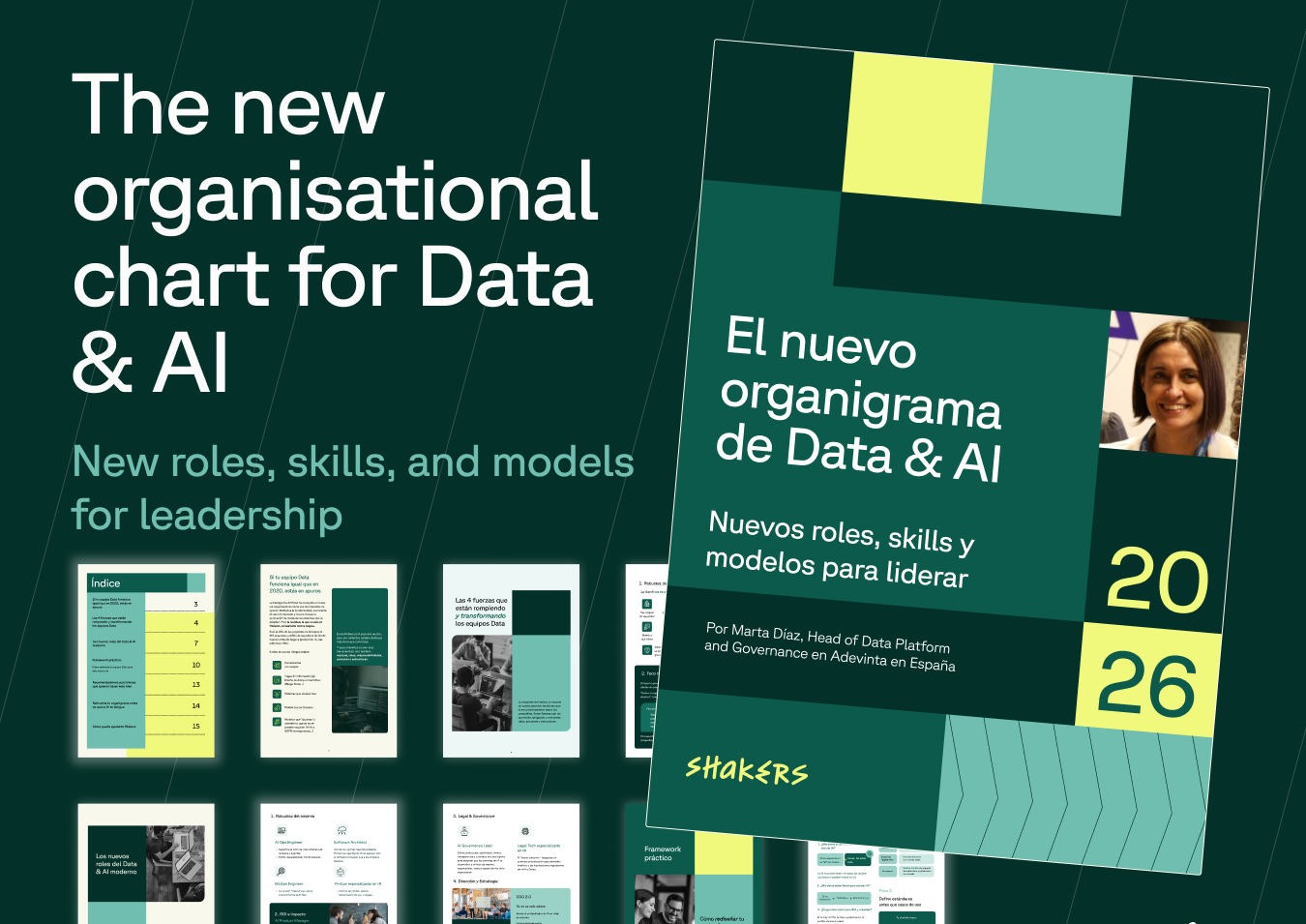
Data & AI's new organization chart
A practical guide to new roles, skills and models for leadership.
Shakers for expert talent
Projects where the JavaScript server is yours: which API gets sustained, which microservice gets deployed and who answers when the queue gets stuck. Shakers connects you with teams whose product already runs on Node.js and needs exactly your stack.
Going independent with a Node.js backend usually starts in an English marketplace or the Reddit thread asking whether it pays a living. Neither tells you how project collaboration works in Spanish, with defined scope and an identifiable company.
What follows is not a study route: it is what gets touched on a real brief, what you are asked to prove and where your territory ends.





















Tech projects published on Shakers
Tech, Product and Data specialisms are part of Shakers
Average length of a project with Shakers
Our AI Builders' satisfaction on Trustpilot
See how other AI Builders access better projects, build their reputation and grow their careers.
Álvaro
Data Scientist
“In a climate this uncertain, Shakers gives you a layer of reassurance and confidence. What I like most, without a doubt, is the flexibility and getting to work on top-tier projects.”
Join Shakers
Amelia
AI Agent Developer
“I have been building AI agents for years. Thanks to Shakers I stopped chasing clients and started genuinely choosing which projects I wanted to work on. I work with some of the best companies in Europe, at my own rate, and I focus on what I am good at and what I love: building.”
Join Shakers
Luz
Backend Developer & Data Engineer
“Shakers adds a lot of value because it connects you with sharper projects, already filtered and better defined. It saves you a big part of the upfront work of understanding the client, quoting and weighing up whether it is worth it, and that means that as a contractor you can go far more directly to the opportunities that genuinely fit you.”
Join Shakers
Rubén
Software Developer
“Life as a contractor has a lot going on and it is not always easy. We like to focus on what we are good at, but you also have to manage clients, invoicing and go looking for work. For me, Shakers has been key because it does that prospecting for me, it gives the client confidence from the very first moment, and it lets us be part of a community with real enthusiasm.”
Join Shakers
Alejandro
AI Developer
“Shakers was key to getting my company off the ground: it gave me the flexibility to keep contracting while I built my next chapter. Without Shakers, I would have had to raise funding or push the project back.”
Join Shakers
Toño
Product Designer
“With Shakers I have landed recurring projects that give me peace of mind and room to grow professionally. It is not just about reaching quality clients: it is feeling that you have a network behind you, one that connects you with real opportunities and helps you move forward as a freelancer.”
Join ShakersA Node.js Developer builds the server side of a product in JavaScript: the browser's language taken to the server. The craft is REST APIs and microservices with Express or NestJS, almost always in TypeScript, with PostgreSQL or MongoDB behind and cloud deployment. It is the most widespread backend specialisation of the JavaScript ecosystem. The boundary: the interface that consumes those APIs belongs to the frontend, and the choice of server language for the whole system, to the generalist backend.
You touch the server of products that already run on JavaScript: APIs that feed web and mobile, microservices with Kafka or Redis in between and integrations that glue foreign systems together. What separates a senior: writing TypeScript the team inherits without fear, with tests, queues and boring deployments.
Free to join, no hidden fees
Tell us who you are, what you can do, the projects you want to work on and what your availability and rate are.
We certify your experience and your use of AI so companies understand and trust what you bring.
We connect you with well-paid projects that fit your expertise and your preferences.

Work on real projects, with teams that need your expertise, without wasting time looking for opportunities.
Work with companies that need your stack and experience to take their projects to production.
Our AI matching connects your profile with the projects that fit your preferences.
Set your own terms based on your seniority. We manage contracts, payments and paperwork.
The API that cannot take any more, the microservice to separate or the integration that fails: a concrete server problem, not a list of technologies.
Documented endpoints, tamed queues and deployments that wake nobody up. What you deliver, the client's team maintains when the milestone closes.
Node.js and TypeScript at the base, Express to start, NestJS when structure grows, PostgreSQL or MongoDB behind and Kafka or Redis when there are events.
Having taken Node.js APIs to production and knowing how to tell them: which endpoint, which queue, what you deployed and what you changed after the first peak.
Split for reasons of scale and team, not fashion: sometimes the well-tested module inside the monolith wins, and defending that.
You build the product's JavaScript server; you do not build the interface nor decide the system's language. If it asks for full stack, you say so at kickoff.
Any other questions? Write to us and we will reply.
The endpoint asked for today, the queue unstuck tomorrow and Friday's deploy. Less fighting asynchrony and more server the team maintains without fear.
1,415 active job ads in Spain mention Node.js, the biggest measured backend market, according to Shakers market analysis (n=31,162, September 2026). The market's senior gets titled with NestJS.
Two doors: the frontend developer who moves to the server with the language they already master, and the backend developer of another language who arrives at npm. Whoever calls themselves a backend JavaScript developer has their row here.
You do not build the interface nor decide the system's architecture. Your product is the JavaScript that runs on the server: its APIs, queues and microservices. If the brief asks otherwise, you say so at kickoff.
A server does not hold the product alone: whoever decides the layer, whoever picks the other runtime and the interface builder cross you.
Node.js is one backend stack, not the whole layer: when the system mixes languages or the decision is global, the brief goes through their repository.
The other server runtime the market compares you with: Go against Node is the question of concurrency and ecosystem. Each project picks a side.
The visible half of the same language: your APIs feed their components on the web. Job ads that bring React and Node in one trade are territory of both.
When the brief brings interface and server in the same package, this profile covers both layers: Node stays as their server half.
The other half of the Node or Python question: their territory leads when the product lives off data. Choosing between the two is a use-case decision.
Boundaries between these roles are agreed per project: the job title doesn't set them.
Take the next step with Shakers
Pass Shakers certification and choose which Node.js projects you take on.

 English
✓
English
✓
At Shakers, we use AI to represent some of our AI Builders, thereby protecting their privacy.