

Álvaro
Data Scientist
“In a climate this uncertain, Shakers gives you a layer of reassurance and confidence. What I like most, without a doubt, is the flexibility and getting to work on top-tier projects.”
Join Shakers
Resources
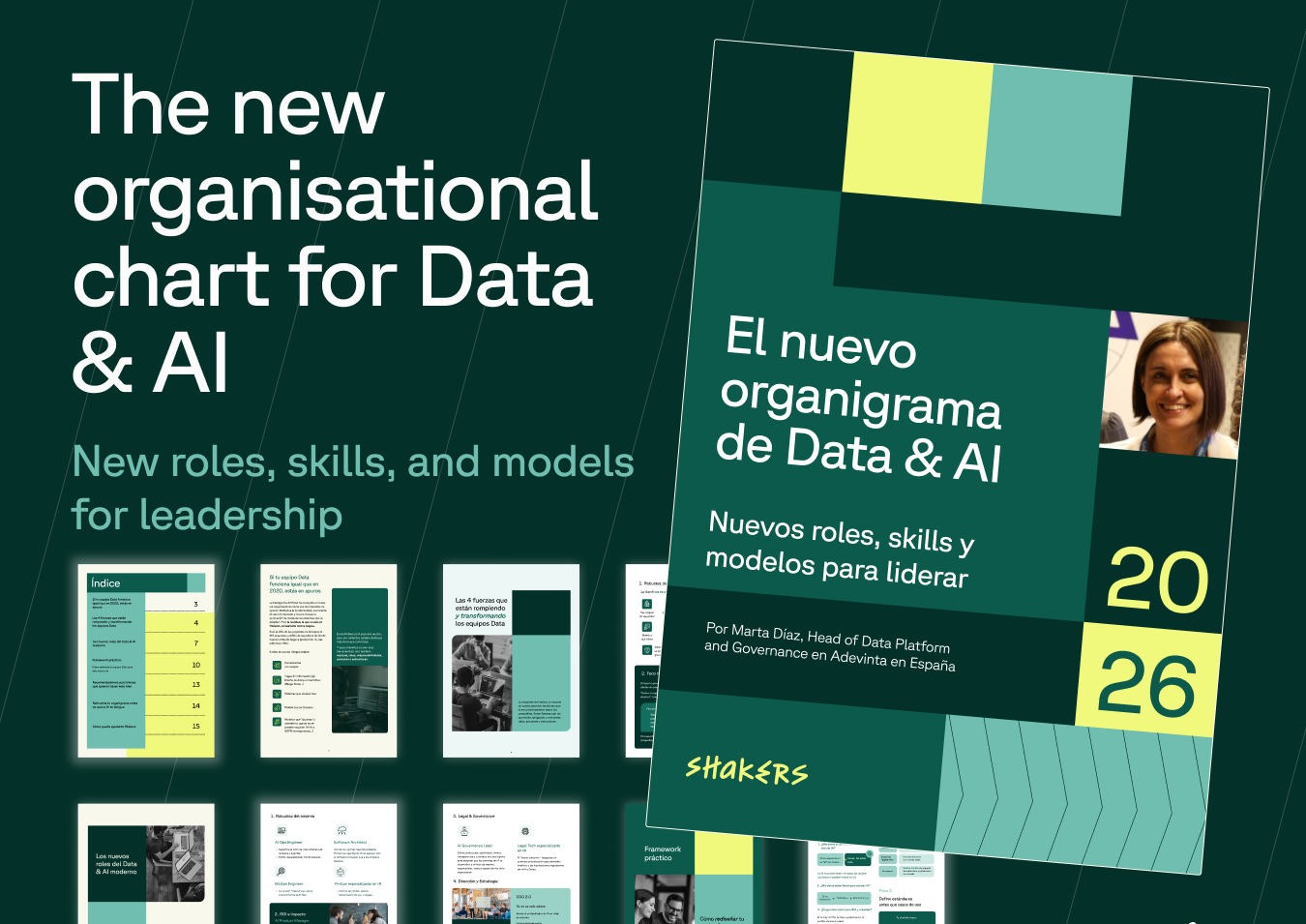
Data & AI's new organization chart
A practical guide to new roles, skills and models for leadership.
Shakers for expert talent
Projects where the cluster is yours: which workload gets orchestrated, what gets declared in Helm and who answers when a pod falls over at 4 a.m. Shakers connects you with teams whose containers are ready and nobody to orchestrate them.
What gets read about the role is either the official documentation or the Reddit thread explaining how to monetise Kubernetes in English. Neither tells you how to start orchestrating a real team's cluster in Spain, brief after brief. Here is that.





















Tech projects published on Shakers
Tech, Product and Data specialisms are part of Shakers
Average length of a project with Shakers
Our AI Builders' satisfaction on Trustpilot
See how other AI Builders access better projects, build their reputation and grow their careers.
Álvaro
Data Scientist
“In a climate this uncertain, Shakers gives you a layer of reassurance and confidence. What I like most, without a doubt, is the flexibility and getting to work on top-tier projects.”
Join Shakers
Amelia
AI Agent Developer
“I have been building AI agents for years. Thanks to Shakers I stopped chasing clients and started genuinely choosing which projects I wanted to work on. I work with some of the best companies in Europe, at my own rate, and I focus on what I am good at and what I love: building.”
Join Shakers
Luz
Backend Developer & Data Engineer
“Shakers adds a lot of value because it connects you with sharper projects, already filtered and better defined. It saves you a big part of the upfront work of understanding the client, quoting and weighing up whether it is worth it, and that means that as a contractor you can go far more directly to the opportunities that genuinely fit you.”
Join Shakers
Rubén
Software Developer
“Life as a contractor has a lot going on and it is not always easy. We like to focus on what we are good at, but you also have to manage clients, invoicing and go looking for work. For me, Shakers has been key because it does that prospecting for me, it gives the client confidence from the very first moment, and it lets us be part of a community with real enthusiasm.”
Join Shakers
Alejandro
AI Developer
“Shakers was key to getting my company off the ground: it gave me the flexibility to keep contracting while I built my next chapter. Without Shakers, I would have had to raise funding or push the project back.”
Join Shakers
Toño
Product Designer
“With Shakers I have landed recurring projects that give me peace of mind and room to grow professionally. It is not just about reaching quality clients: it is feeling that you have a network behind you, one that connects you with real opportunities and helps you move forward as a freelancer.”
Join ShakersA Kubernetes Engineer designs, deploys and sustains clusters of containers: they write the manifests and Helm releases that declare how each service lives, configure the autoscaling and self-healing with which the platform recovers on its own, and run the engine with kubectl across the three clouds (EKS, AKS, GKE). Helm, GitOps and operators are their daily workshop; orchestration is the craft.
You decide which workload gets orchestrated and with what resources, what gets declared in Helm and what stays outside, which rollout enters and how, and who answers when a pod falls at 4 a.m. You also decide what the engine refuses: a release without rollback does not go in. The cluster is the team's; the orchestration that keeps it alive, yours.
Free to join, no hidden fees
Tell us who you are, what you can do, the projects you want to work on and what your availability and rate are.
We certify your experience and your use of AI so companies understand and trust what you bring.
We connect you with well-paid projects that fit your expertise and your preferences.

Work on real projects, with teams that need your expertise, without wasting time looking for opportunities.
Work with companies that need your stack and experience to take their projects to production.
Our AI matching connects your profile with the projects that fit your preferences.
Set your own terms based on your seniority. We manage contracts, payments and paperwork.
Shakers is hiring infrastructure: the project arrives with the containers ready and the jump to production pending, not with a list of technologies.
You deliver the manifests, the Helm releases and the reasoning behind each scaling decision, including what you decided not to orchestrate and why.
You set the rollout strategy, the rollback and who answers in each window. The small hours get designed before the first failure.
Having operated real production and knowing how to tell the story of a failure: what broke, what you did and what changed so it never repeated.
Choosing the cluster by the real size of the problem, not fashion. Sometimes the honest answer is plain Docker, and defending it.
You orchestrate the engine; you don't write the application or design the cloud. If the project needs pipeline or architecture, you say so at kickoff.
Any other questions? Write to us and we will reply.
The pod that heals itself at 4 a.m., the Helm release you review before deploying and the node that joins and leaves the cluster unnoticed. Less manual firefighting, more platform that holds itself up.
4,426 active tech job ads in Spain mention kubernetes and 606 ask for Helm, according to Shakers market analysis (n=31,020, September 2026). Terraform and Ansible close the stack.
Two frequent doors: the DevOps Engineer who inherited the cluster, and the sysadmin who came from virtual machines. The CKA (Certified Kubernetes Administrator) certification seals the level in both.
Not the course that explains what a pod is, nor the architect who designs the cloud: if the problem is the pipeline, the role is DevOps; if it is architecture, Cloud Architect. Your ground is the engine.
Five roles from the collective cross your path while you orchestrate containers: who deploys, who designs the cloud, who audits it.
The duo the market publishes together: their pipeline deploys what your cluster orchestrates. Many Kubernetes Engineers come from DevOps.
Kubernetes is their core stack: when the cluster runs and what pages you is reliability, on-call and incidents become theirs.
Designs the cloud where your cluster lives: their platform and cost decisions are the ceiling of what your orchestration can sustain.
The Amazon ecosystem specialist: when the cluster is EKS, infrastructure and orchestration split the brief.
Audits the cluster for ISO 27001 or ENS: RBAC, network policies and secrets reviewed alongside your work when the project must comply.
Boundaries between these roles are agreed per project: the job title doesn't set them.
Take the next step with Shakers
Pass Shakers certification and choose which orchestration projects you take on.

 English
✓
English
✓
At Shakers, we use AI to represent some of our AI Builders, thereby protecting their privacy.